Alibaba Releases Qwen 3.6: Open Models Move Toward Coding Agents
Alibaba's Qwen 3.6 releases show that the open-weight AI race is shifting toward coding agents, long context, tool use, and real-world developer workflows.
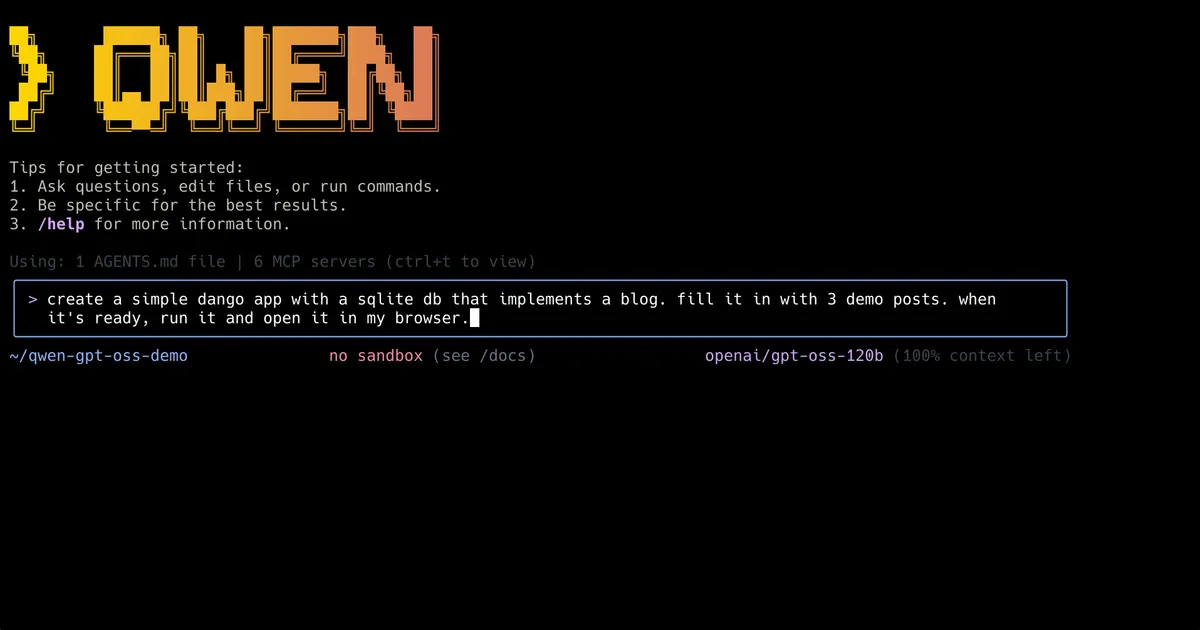
Alibaba Releases Qwen 3.6: Open Models Move Toward Coding Agents
Alibaba’s Qwen team has released Qwen 3.6 models aimed squarely at coding agents, long-context reasoning, and tool-using workflows. The launch shows that the open-weight model race is no longer just about chatbot quality; it is increasingly about whether open models can operate inside real software environments.
The News in Brief
Alibaba’s Qwen team has been rolling out Qwen 3.6 models across hosted APIs and open-weight releases, including Qwen3.6-35B-A3B and Qwen3.6-27B model cards on Hugging Face. The releases build on the Qwen3 line and focus heavily on agentic coding, long-context input, tool calling, structured outputs, and practical developer deployment.
The most developer-relevant release is Qwen3.6-35B-A3B, a mixture-of-experts model with 35 billion total parameters and around 3 billion active parameters. Qwen describes it as supporting 256K native context and up to 1 million tokens with extrapolation techniques. The model is released under the Apache 2.0 licence.
Alibaba has also published a Qwen3.6-27B dense model, aimed at strong open-weight performance without the operational complexity of a larger MoE system. The broader message is clear: Qwen is competing for the developer workflows where coding agents, repository-scale context, terminal use, and tool orchestration matter.
What Was Actually Announced
The Qwen 3.6 story is not one single model dropped in isolation. It is a family strategy.
The open-weight side includes models such as Qwen3.6-35B-A3B and Qwen3.6-27B. These are the releases most relevant to developers who want to self-host, fine-tune, inspect weights, or run models inside their own infrastructure. The 35B-A3B model is especially interesting because it uses a mixture-of-experts design to keep active parameters low while preserving broader capacity. The 27B model is a more conventional dense release, which may be easier for some teams to deploy and reason about.
Alibaba’s hosted Qwen products sit alongside these releases. In practice, that means the company is competing in two markets at once: API-based frontier services for users who want convenience, and open-weight models for developers who want control.
What is available now is the model weights, model cards, and deployment guidance for the open releases. The Hugging Face pages describe context length, licence terms, inference recommendations, and supported frameworks. The models are intended for text generation, coding, tool use, reasoning, multilingual use, and agent-style tasks.
What is more loosely promised is the surrounding agent ecosystem. A model card can say a model supports tool calling, but a productive coding agent requires much more: shell access, repository indexing, edit planning, test execution, permissions, rollback strategy, browser or documentation access, and good UX around review. Qwen is supplying an increasingly capable model layer, but the agent product layer still depends on frameworks and downstream builders.
The most important reality check is this: Qwen 3.6 is not only trying to beat other open models on benchmarks. It is trying to become a practical base for open coding agents.
The Technical Angle
Qwen3.6-35B-A3B is a sparse mixture-of-experts model. It has 35 billion total parameters, but only about 3 billion active parameters per token. That is the key efficiency move. A dense 35B model uses the whole network for every token; a sparse MoE routes each token through a subset of experts, aiming to deliver better capability per unit of inference cost.
The long-context story is central. Qwen lists 256K native context for Qwen3.6-35B-A3B, with support for up to 1 million tokens using extrapolation methods such as YaRN. That matters because coding agents need to hold much more than a prompt. They need repository files, issue descriptions, dependency graphs, test output, logs, documentation snippets, diffs, and prior tool calls.
Alibaba’s Qwen releases also continue the hybrid thinking and non-thinking pattern from earlier Qwen3 models. In practical terms, that means the model can be used in faster direct-answer mode or in a more deliberate reasoning mode, depending on the task. For coding, that flexibility matters: not every autocomplete or small refactor needs expensive reasoning, but debugging a failing integration test often does.
Tool use is another technical focus. Modern coding agents need to emit structured calls, understand function schemas, interpret tool results, and continue a plan after a failed command. Open models have historically lagged closed systems here because tool use is not only a language task; it depends on post-training, data quality, execution traces, and reliable formatting.
Compared with earlier Qwen models, the 3.6 releases appear more explicitly tuned for agent workflows rather than generic chat. Compared with DeepSeek’s recent long-context models, Qwen is competing on a similar axis: open weights, large context, coding, and lower deployment cost. Compared with closed models from OpenAI, Anthropic, and Google, the tradeoff is familiar: more control and inspectability, but more operational responsibility and often less polished product integration out of the box.
Why It Matters
Qwen 3.6 matters because coding is becoming the proving ground for serious AI systems.
Chat quality is still useful, but coding agents expose whether a model can do work. The model has to read a codebase, infer intent, make a plan, edit files, run tests, understand failures, try again, and stop before it damages unrelated parts of the project. That is much closer to real economic value than answering a benchmark question in isolation.
For developers, open Qwen models offer another route away from fully closed coding assistants. A company can run an open model inside its own environment, keep source code under tighter control, customise workflows, and experiment with agent frameworks without sending every repository interaction to a third-party API.
For enterprises, the significance is governance. Coding agents will touch sensitive intellectual property, infrastructure code, credentials, customer data, and deployment pipelines. Open-weight options are not automatically safer, but they give security teams more architectural choices.
For the AI industry, Qwen 3.6 increases pressure on the closed-model labs. If open models become good enough for routine coding-agent work, the premium tier of commercial models has to justify itself through reliability, integration, safety, latency, and support rather than raw benchmark advantage alone.
Is this new ground or incremental? It is incremental technically, but strategically important. The direction is clear: open models are moving from “can chat and code” toward “can operate as software agents.”
The Reaction
The developer reaction has focused on practical deployment questions: how well the models run locally, how stable long-context behaviour is, and whether the tool-calling performance is reliable enough for coding agents.
Open-model advocates have welcomed the Apache 2.0 licensing and the availability of both sparse and dense options. The 35B-A3B release is attractive because the active-parameter count suggests a potentially efficient path for serving, while the 27B dense model may be easier for teams that prefer simpler inference behaviour.
There is also healthy scepticism. Model cards and benchmark tables do not fully predict agent performance. Coding agents fail in mundane ways: they edit the wrong file, misunderstand a test fixture, ignore a linter, overwrite user changes, or keep looping after a tool failure. Those failures are not always visible in headline coding benchmarks.
Competitively, Qwen is now discussed in the same breath as DeepSeek, Llama, Mistral, and other serious open-model families. That is the real shift. Alibaba is no longer merely producing capable chat models; it is becoming one of the important suppliers in the open agentic-coding stack.
The Caveats and Open Questions
The first caveat is that “agentic” can be a slippery word. A model that can format tool calls is not automatically a good agent. Real agent performance depends on scaffolding, memory, permissions, test loops, retrieval, sandboxing, prompt design, and the surrounding product.
The second caveat is long-context reliability. A 256K or 1 million-token context window is valuable only if the model uses the context well. Long context can create false confidence: the model may technically see the relevant file but still ignore a small constraint, misread a dependency, or over-weight stale information from earlier in the conversation.
The third caveat is deployment complexity. Sparse MoE models can be efficient, but they are not always simple to serve. Teams need the right inference engine, routing support, quantisation strategy, memory planning, and hardware profile. A dense 27B model may be operationally easier even if the MoE model looks more efficient on paper.
There are also security questions. Coding agents need controlled access to files, terminals, packages, secrets, and deployment systems. Open weights give organisations more control, but they do not remove the need for sandboxing, audit logs, approval gates, and careful permission design.
Finally, benchmark comparability remains messy. Coding benchmarks often differ by prompt format, tool access, pass criteria, contamination risk, and whether the model is allowed to iterate. Qwen 3.6 may be strong, but businesses should evaluate it on their own repositories, languages, test suites, and failure tolerance.
What Comes Next
The next milestone is agent integration. Watch how quickly Qwen 3.6 models appear inside open coding-agent frameworks, IDE extensions, local developer tools, and enterprise self-hosted assistants.
The second milestone is independent evaluation. Repository-level tasks, SWE-style issue resolution, terminal workflows, and long-context codebase navigation will matter more than generic chat scores.
The third milestone is economics. If Qwen can deliver useful coding-agent performance at materially lower serving cost, it will force every AI coding product to compete harder on workflow quality rather than model access alone.
The broader trend is clear. Open models are moving toward the same place as closed frontier systems: agents that use tools, work across long contexts, and complete real tasks. Qwen 3.6 is important because it shows that this race is now open-weight as well.
Transformer AI helps SMEs navigate the AI landscape without the jargon. If you would like a frank conversation about what open coding agents could mean for your business, get in touch.

Stephen Donnelly
Tags: